
The eSourcing software market is crowded.
New platforms seemingly launch every month. Marketing promises pile up. Feature lists blur together. And if you’re running procurement at a mid-market company, cutting through the noise is exhausting.
You don’t need another enterprise suite with a two-year implementation timeline. You don’t need software designed for Fortune 500 procurement teams with unlimited budgets and dedicated IT support.
You need:
- Tools that work
- Fast to implement
- Easy to use
- With great UI/UX
This article cuts through the vendor marketing. We focus on eSourcing software that helps lean procurement teams who need to deliver results without massive transformation projects.
We’re seeing a few clear trends in the eSourcing market.
- Many solutions that started out as eSourcing tools have morphed into Source-to-Contract software.
- There are more vertical-specific solutions targeting sourcing events for specific industry sectors or spend categories.
- A growing number of platforms built specifically for non-enterprise customers. These tools prioritise user experience over feature bloat. They implement in weeks, and don’t require external consultants to make them work.
This article reflects all of these trends.
Let’s first dig a bit deeper into what we’re looking at.
10 best eSourcing software and Sourcing Enablement tools in 2026
Before we dive into the specific tools, let’s clarify what we mean by eSourcing software.
This article focuses on standalone eSourcing tools. These broadly fall into two categories:
1. Sourcing Enablement Tools
These are general-purpose tools.
They help procurement teams to prepare competitive bidding events across various spend categories. These applications assist with all types of actions that enable faster sourcing decisions. For example:
- Supplier discovery
- Statement of work drafting
- Supplier outreach and offer comparison
- Autonomous sourcing and negotiation for tail spend
2. Niche eSourcing Software
These platforms specialise in specific product or service categories. Examples here include:
- apadua for professional services
- ProcureForce for manufacturing businesses
- Alpas for components They offer deep functionality tailored to the unique requirements of their target category.
How eSourcing Tools differ from Source-to-Contract (S2C) Platforms
The tools covered in this article assist and enable the sourcing process. They help you run competitive events efficiently and to streamline supplier communication. They facilitate bid analysis.
But they don’t manage the complete end-to-end strategic sourcing lifecycle for all categories.
Source-to-Contract platforms handle everything from initial supplier research through RFI/RFP, bid evaluation, contract negotiation, signature, and ongoing contract management. We’ll be covering S2C platforms in a separate article soon.
Some of the niche category specific eSourcing tools in here offer full stack sourcing capabilities, specifically designed for that category of spend. But that’s not to confuse them with more generic S2C platforms.
The eSourcing tools in this article occupy a different space. They’re designed to make specific parts of your sourcing activities faster and more effective. They’re not trying to be everything to everyone.
What about eAuctions?
None of the platforms included here are pure eAuction tools.
They’re primarily focused on RFx management and supplier collaboration. Dedicated eAuction platforms deserve their own separate treatment. It’s also worth noting that many – but not all – Source-to-Contract platforms also offer eAuction capabilities.
These Tools Are Within Reach of Mid-Market Businesses
Here’s the good news.
All the platforms featured in this article are accessible to mid-market companies. Your business doesn’t need to be a Fortune 500 enterprise to benefit from these solutions.
Sure, there are some of these software vendors who serve large enterprises too. But, they’ve designed their products to also work for businesses in the $100 million to $1 billion revenue range. That means reasonable pricing, sensible implementation timelines, and user experiences that don’t require a team of consultants to navigate.
This is not sponsored content
No provider has paid to appear on this list. Ask yourself whether the same is true of other similar articles you read.
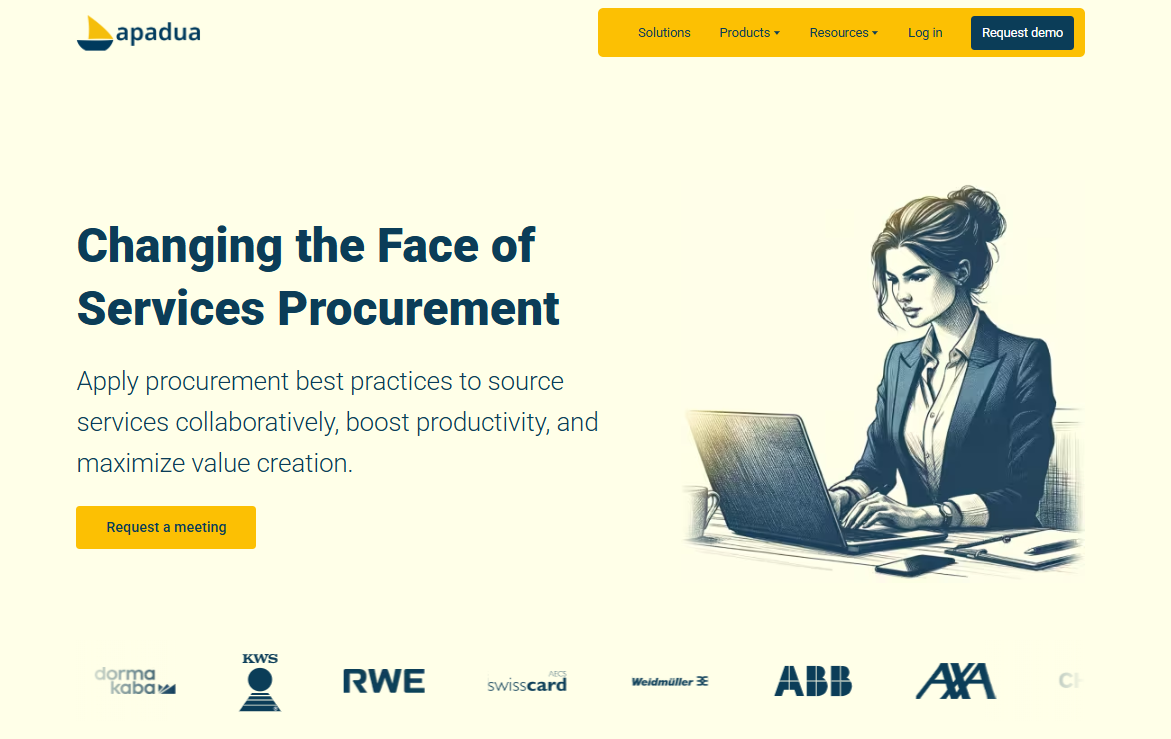
1. apadua

Apadua is one of the few eSourcing innovators focusing exclusively on professional services, a notoriously complex category to manage. The company brings structure to how organisations source consulting, IT, and legal providers. Categories where briefs are often ambiguous and outcomes are hard to measure. Its modular suite combines automation, analytics, and a curated marketplace, guiding teams from project scoping to supplier performance. Through its Apalytics insights engine, Apadua enables data-led decisions that bridge the gap between sourcing efficiency and strategic value.
Key Info:
- Founder / CEO: Gregory N. Vider
- Year founded: 2016
- Number of employees: 11-50
- Headquarters: Cologne, Germany
- Industry sectors served: Technology/IT services, healthcare, education, financial services, insurance, manufacturing
2. mysupply

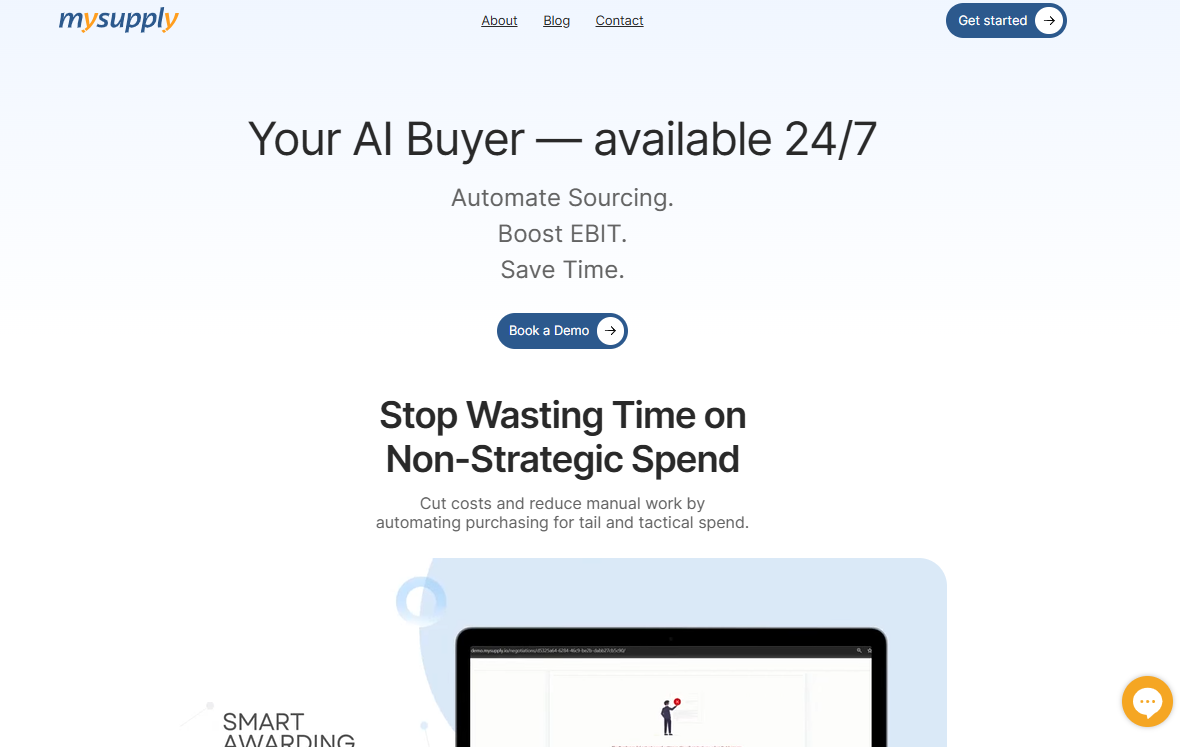
Mysupply represents a new generation of sourcing platforms designed to make tactical procurement faster and smarter.
Built with automation at its core, the solution streamlines repetitive sourcing and negotiation tasks, allowing teams to focus on strategic priorities. Its AI Buying Assistant and Autonomous Negotiation features have proven to shorten cycle times and deliver savings of up to 11%. Combined with plug-and-play ERP connectivity and a partnership with Amazon Business, mysupply stands out for its flexibility and ease of deployment.
Key Info:
- Founder / CEO: Andreas Zimmermann
- Year founded: 2020
- Number of employees: 11-50
- Headquarters: Hamburg, Germany
- Industry sectors served: Industrial manufacturing, automotive, oil & gas/energy, telecommunications.
3. Deployed
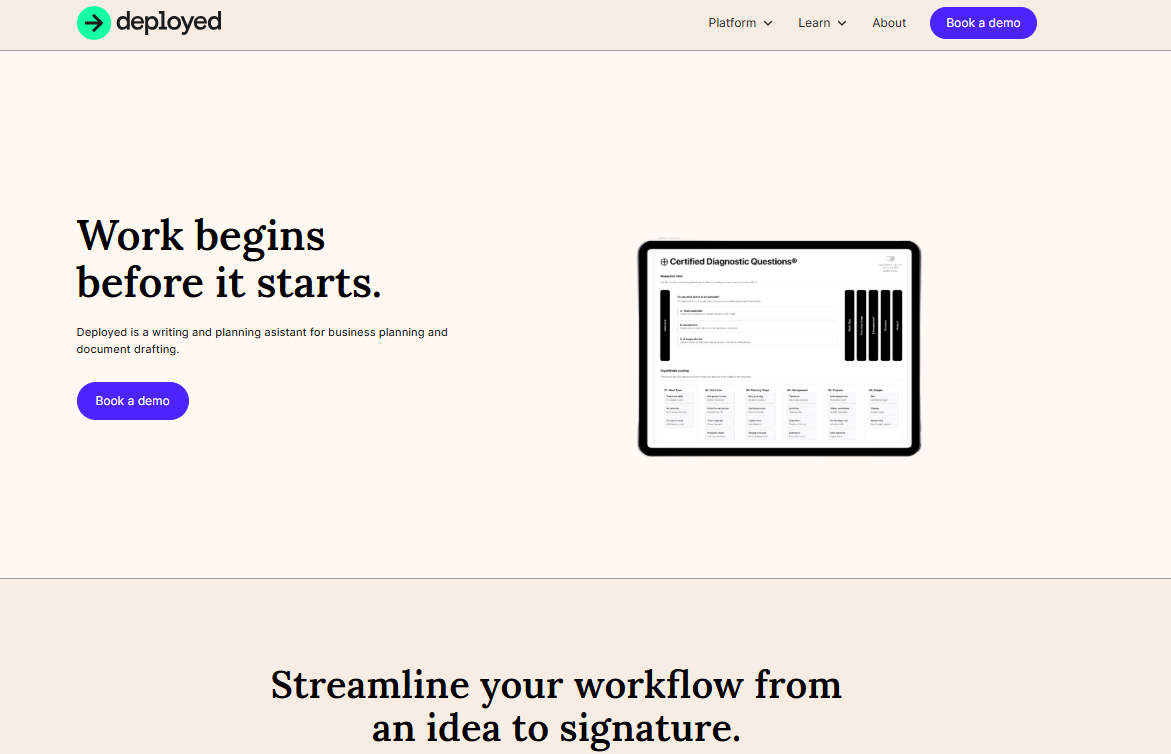
Deployed has become a trusted solution for organisations looking to bring rigour to service procurement. The company focuses on the creation and management of Statements of Work (SoWs), an area often riddled with inconsistency and delays. Using AI and decision logic, it replaces manual templates with Guided Scoping® workflows that improve speed and compliance. With built-in ERP and VMS integrations, Deployed ensures service engagements are transparent, auditable, and strategically aligned.
Key Info:
- Founder / CEO: Kayleigh Ciara Kuptz
- Year founded: 2019
- Number of employees: 11-50
- Headquarters: London, UK
- Industry sectors served: Technology & digital, supply chain & logistics, HR & workforce services, marketing & operations, real estate & facilities, sustainability
4. OnSource

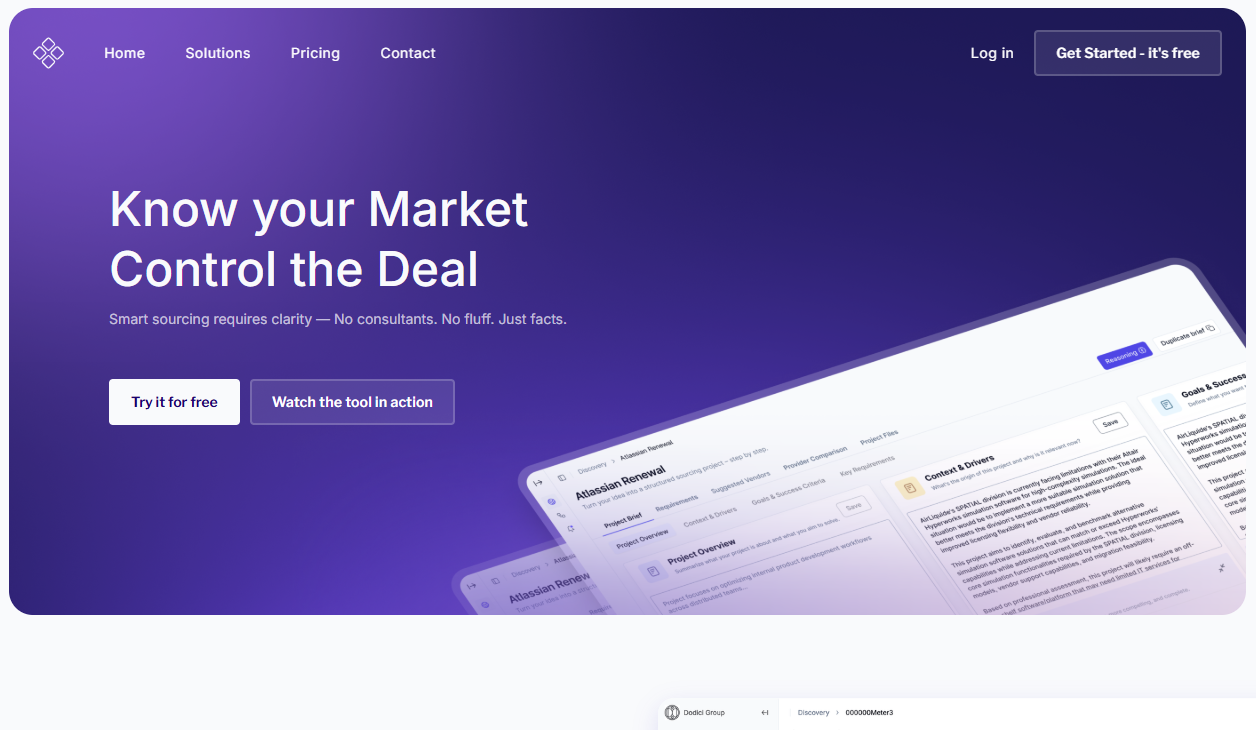
OnSource has quickly established itself as a specialist in software procurement and renewal optimisation.
Its AI-powered technology automates vendor sourcing, bid collection, and negotiation support, helping companies save time while securing better deals. By analysing internal spend alongside competitive benchmarks, OnSource ensures renewals happen under optimal conditions.
Its intelligent automation doesn’t just recommend vendors. It actively engages them, transforming software buying from a reactive task into a strategic advantage.
Key Info:
- Founder / CEO: Thomas Audibert
- Year founded: 2023
- Number of employees: 2-10
- Headquarters: Paris, France
- Industry sectors served: IT & Software, Financial Services, Manufacturing, Healthcare, Retail & E-commerce
5. Matchory

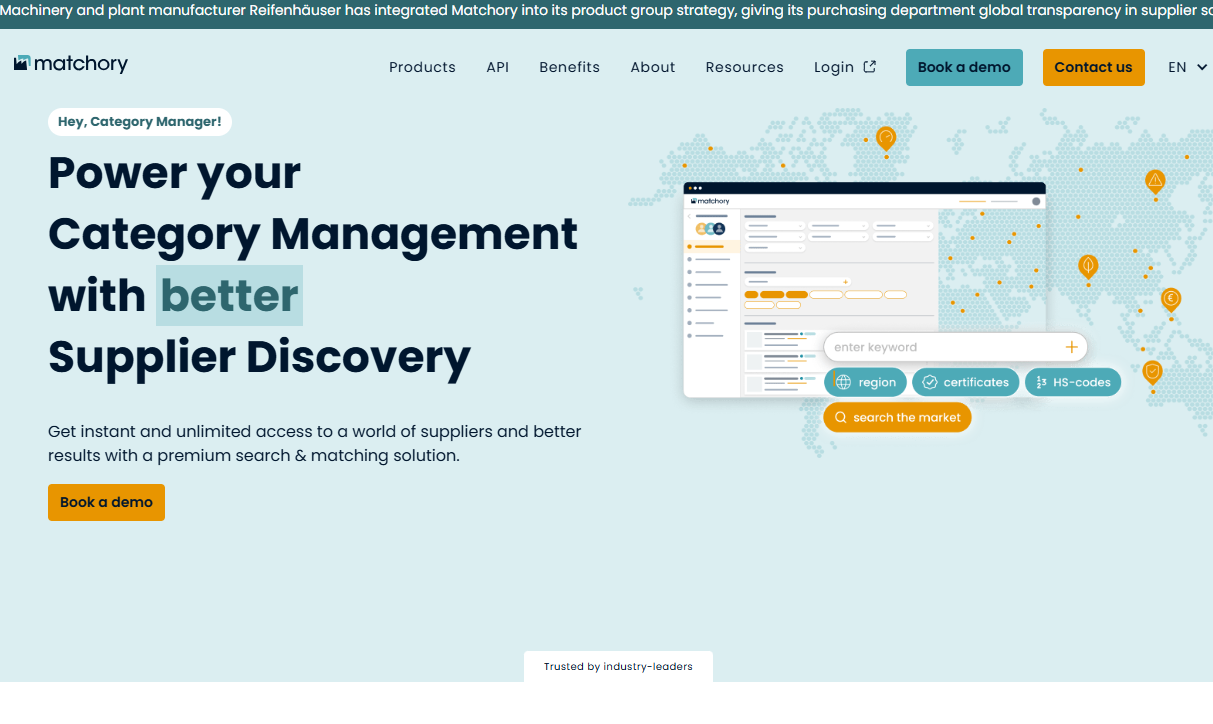
Matchory is redefining supplier discovery by applying AI and big data to what was once a slow, manual process.
The company’s platform gives procurement teams instant access to over 14 million verified suppliers worldwide, automatically matching them with the most relevant and compliant options. Through live data and risk assessments, Matchory helps organisations make smarter sourcing decisions and build stronger, more resilient supply chains.
Key Info:
- Founder / CEO: Aiko Wiegand
- Year founded: 2019
- Number of employees: 11-50
- Headquarters: Ulm, Germany
- Industry sectors served: Manufacturing, engineering, automotive, electronics, industrial equipment, and consumer goods
6. Find My Factory

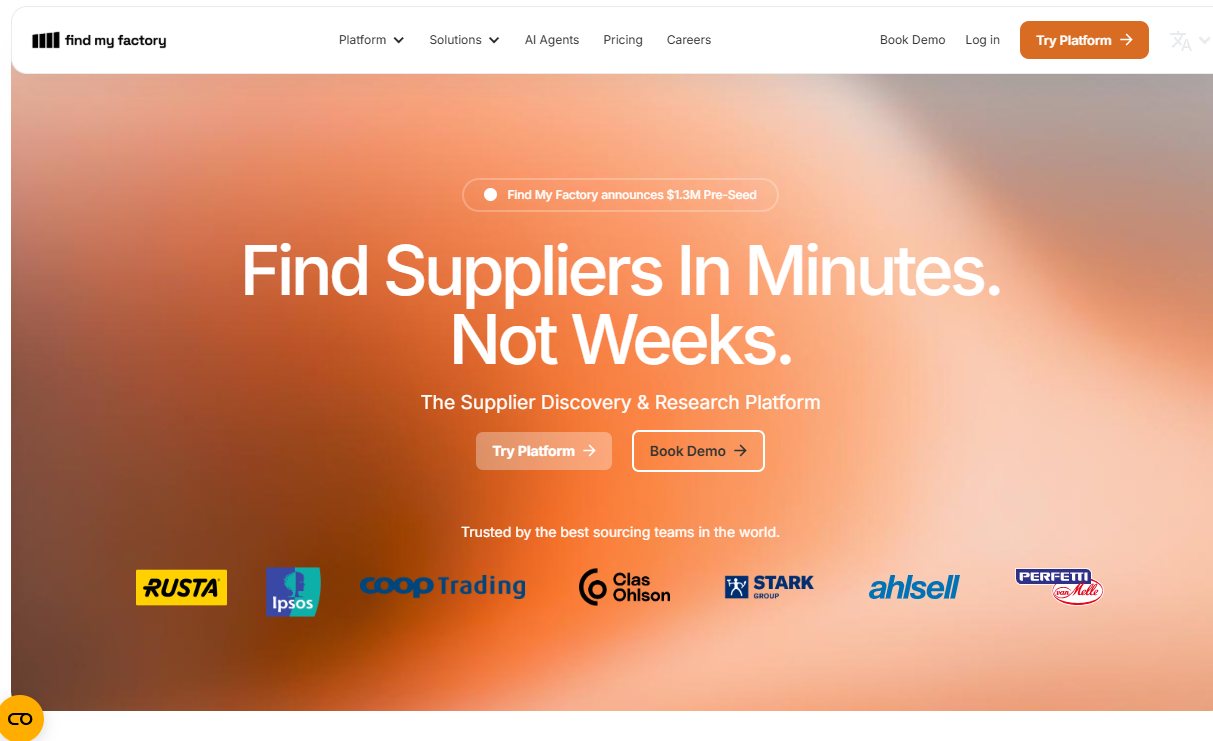
Find My Factory is bringing speed and precision to supplier research for manufacturing businesses.
Using autonomous AI agents, the platform automates supplier identification, vetting, and outreach, turning what used to take weeks into a matter of hours. Users can upload product images or trade fair data to generate qualified shortlists enriched with compliance and certification details.
By integrating with ERP systems and eliminating manual effort, Find My Factory enables procurement teams to move faster and make data-driven sourcing decisions.
Key Info:
- Founder / CEO: Martin Schneider
- Year founded: 2022
- Number of employees: 11-50
- Headquarters: Stockholm, Sweden
- Industry sectors served: Food & Beverage, Industrial & Manufacturing, Retail & Consumer Goods, Automotive & Transportation, Technology & Electronics, and Supply Chain & Logistics.
7. Soource
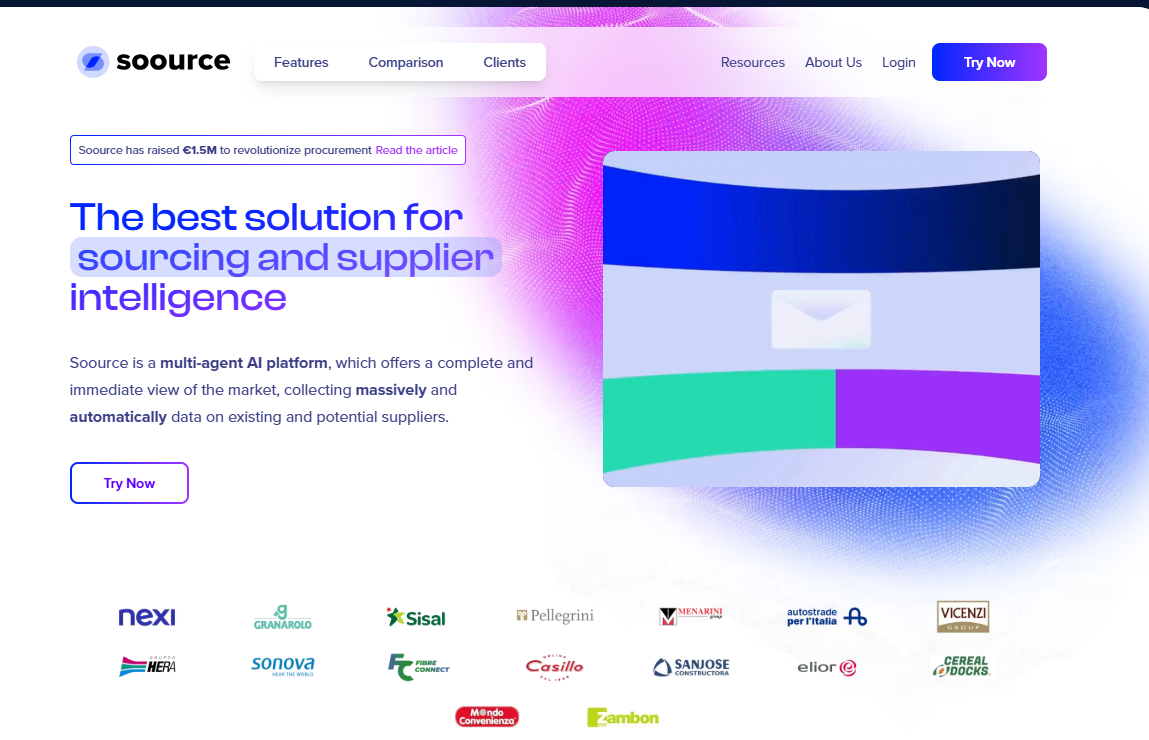
Soource is emerging as a go-to tool for procurement teams overwhelmed by supplier communication.
The company uses AI-powered email orchestration to automate supplier outreach, quote collection, and comparison, bringing order to what was once an unstructured process. Its clean interface turns scattered email threads into structured sourcing data, while a benchmarking dashboard makes evaluating offers straightforward.
Designed for growing procurement teams, Soource bridges the gap between simplicity and insight.
Key Info:
- Founder / CEO: Maicol Verzotto
- Year founded: 2023
- Number of employees: 2-10
- Headquarters: Bolzano, Italy
- Industry sectors served: Information Technology and Software, Manufacturing and Industrial, Retail and E-commerce, Construction and Engineering, Professional Services, and Logistics and Supply Chain.
8. Arkestro
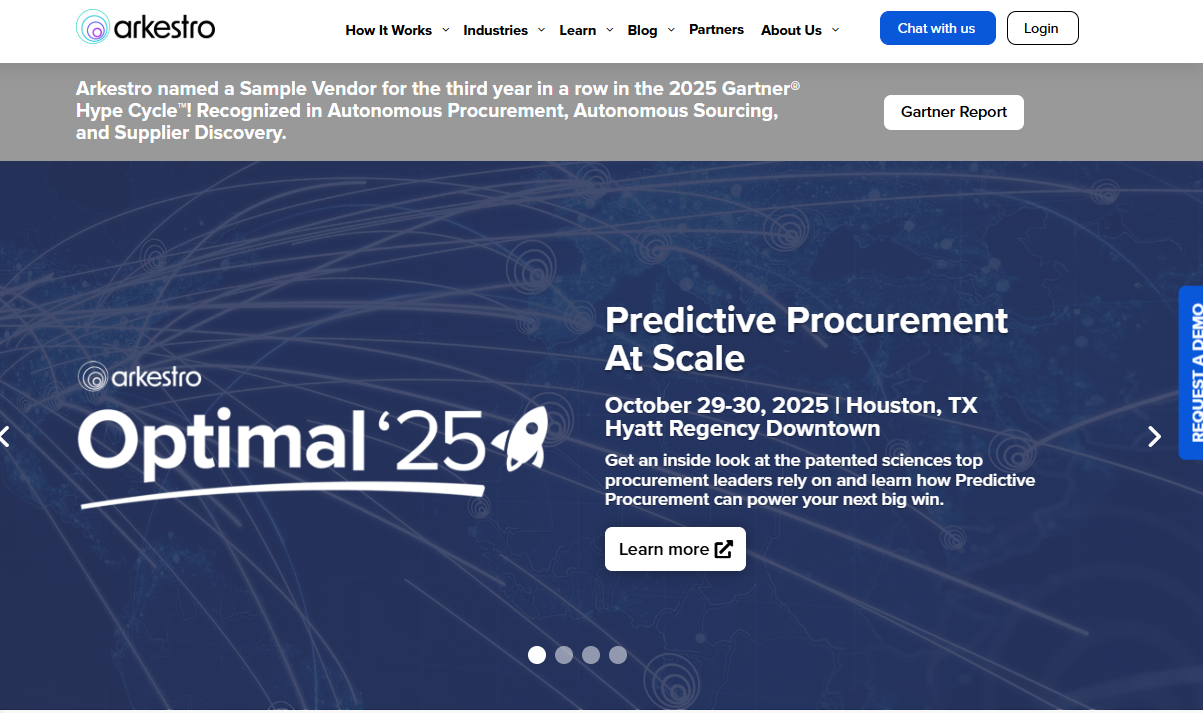
Arkestro sits at the intersection of AI, behavioural science, and predictive analytics.
The company’s platform helps procurement teams anticipate optimal pricing and negotiation outcomes before a sourcing event even begins. By modelling supplier behaviour and using machine learning to forecast results, Arkestro enables buyers to act proactively rather than reactively. Its deep ERP and P2P integrations make it particularly well-suited for manufacturing businesses and enterprises seeking to unlock value from every sourcing event.
Key Info:
- Founder / CEO: Rob DeSantis
- Year founded: 2017
- Number of employees: 51-200
- Headquarters: San Francisco, California
- Industry sectors served: Oil & gas, automotive, manufacturing, construction, financial services, food & beverage
9. Alpas AI

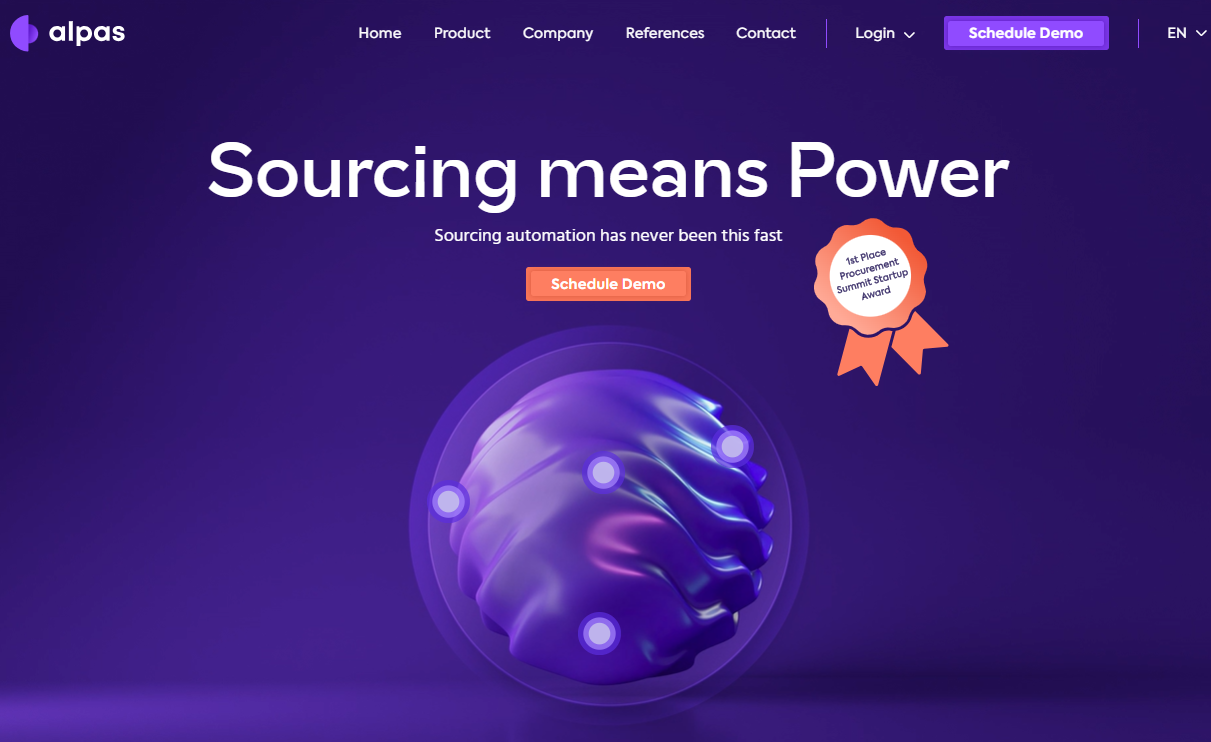
Alpas AI provides manufacturers with a unified view of their global supply base, powered by machine learning and real-time analytics.
The company aggregates supplier data from multiple sources and enriches it with risk, performance, and geopolitical indicators. This intelligence enables procurement teams to manage compliance, anticipate disruption, and identify new sourcing opportunities faster. For industrial buyers handling complex categories, Alpas AI turns supplier management into a strategic data exercise.
Key Info:
- Founder / CEO: Isabel Poppek
- Year founded: 2020
- Number of employees: 11-50
- Headquarters: Berlin, Germany
- Industry sectors served: Manufacturing, engineering, electronics, logistics, automotive, industrial components
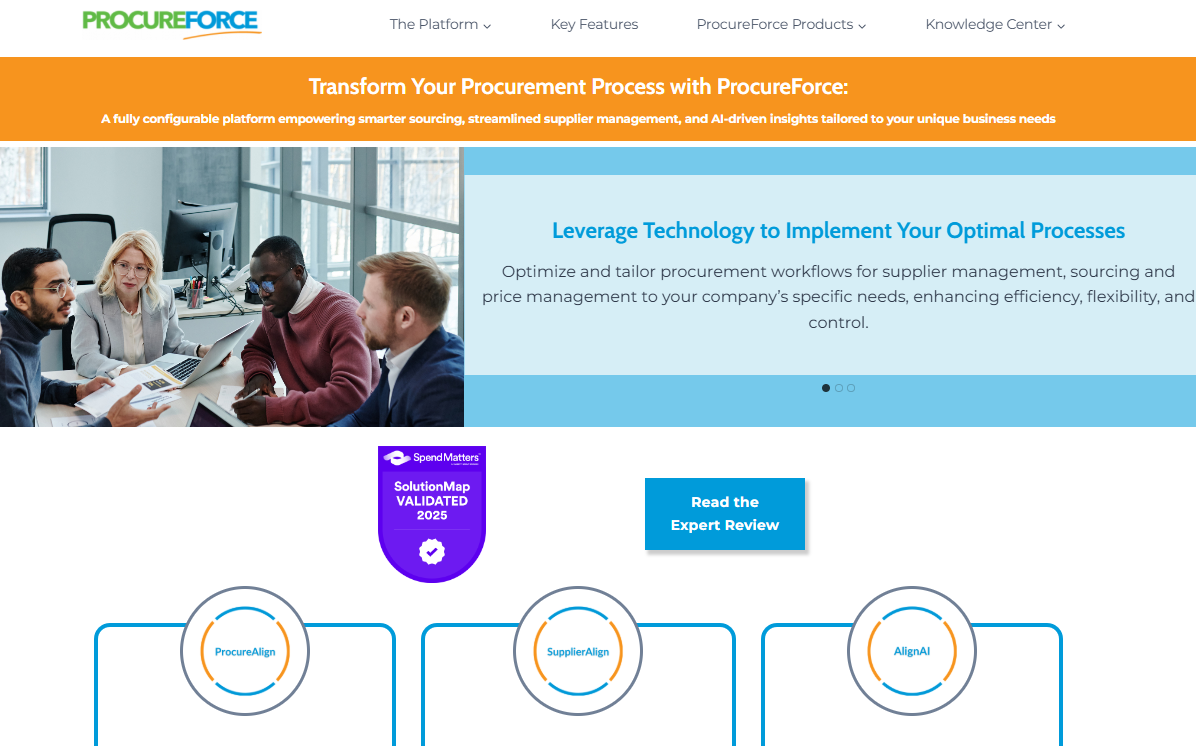
10. ProcureForce
ProcureForce has deep roots in manufacturing and direct materials sourcing.
Built to manage complex bills of materials, the platform brings together sourcing workflows, supplier collaboration, and cost analysis in one system. Its AlignAI engine structures sourcing data and integrates with BI tools like Power BI and Tableau for real-time insights.
Designed by procurement experts, ProcureForce delivers the speed, control, and visibility required by automotive, aerospace, and industrial manufacturers.
Key Info:
- Founder / CEO: Jeoff Burris
- Year founded: 2008
- Number of employees: 2-10
- Headquarters: Plymouth, Michigan
- Industry sectors served: Automotive, aerospace, manufacturing, engineering, heavy industrial equipment
Which is the best eSourcing or sourcing enablement software?
Start with the end in mind!
Many of these solutions are pretty niche specific for one type of industry. While these are often overlooked in more traditional lists of eSourcing tools, I wanted to include them in here. Shining a light on some of the sourcing enablement and niche eSourcing software that’s out there is long overdue.
Why eSourcing Software Is Easier to Justify
eSourcing tools typically don’t require integration with your existing ERP system or procure-to-pay (P2P) platform.
This is a huge advantage when it comes to building a business case.
No complex integrations mean:
- Lower implementation costs
- Faster time to value
- Less IT involvement
- Fewer technical dependencies.
The ROI becomes much easier to calculate and justify.
You’re not asking Finance for a multi-year, multi-million dollar commitment. You’re proposing a focused investment that can demonstrate value within weeks or months through hard, P&L-visible savings that are generated through the platform.
For mid-market procurement teams, this certainly makes eSourcing software or sourcing enablement platforms an ideal first step into digital transformation. You can prove the value of technology, without having to bet the farm on a complex suite implementation.
Only you know what’s needed most urgently for your organization.
- Are you suffering from a chaotic process with IT sourcing?
- Or maybe you need help with drafting Statements of Work?
- Perhaps tail spend is out of control, and the only way to put a lid on it is to enable autonomous sourcing?
If you’d like to have a chat about how we can help you source the best software for your requirements, then go ahead and schedule a free intro call with us!