
Category management software was one of the final frontiers for procuretech. Along with services procurement and automated negotiation bots, this is certainly a tougher nut to crack than procure-to-pay software.
Not any more.
There are now four category strategy software solutions on the market who cite this as their primary feature.
Add to that list the additional suites and best-of-breeds who also include certain aspects of category management in their offering. For example, Contract Lifecycle Management software or Supplier Relationship Management tools.
So, it begs the questions:
- How much of the heavy lifting can it do?
- And do we think it’s worth the investment?
Is Category Management software really a game changer?
I hate to give the typical consultant’s answer here but…
It depends.
In many cases, it can free up much needed resources to do more important tasks. Nobody on a Procurement Category Manager salary should be banging their head against a wall formatting Power Point presentations.
On the other hand, it could be an expensive white elephant if your organisation lacks the maturity to give it a chance of return on investment. More on this later.
Putting it very bluntly, if procurement’s role in your company is to say “yes” to stakeholders without challenging them, then none of these products will change the game.
It’s not the software’s fault.
The symptom is your CEO who needs to change his or her mindset. Either that, or your CPO needs to grow a backbone and improve their communication skills. It’s quite possibly a bit of both.
Why do we need category strategy software?
As is the case with most technology, it’s there to eliminate spade work from procurement category managers.
Category management software is not a silver bullet. It can’t magically give us spend analysis, SWOT, PESTLE and every other consultant’s diagram in an eloquent presentation.
It’s there to save us time.
But, we’re responsible for feeding it what it needs. If your data is garbage, it will present you garbage. It may be presented in a nice dashboard, but it’s still garbage. The business shouldn’t be making potential decisions based on inaccurate or incomplete data.
Where it can really help is by guiding us through the process step-by-step in a logical manner. It will prompt us to consider the needs of the business. This goes beyond just a category silo in which the procurement manager can sometimes get stuck.
It will leverage AI and machine learning in some cases to help us think beyond our walled garden. Access to e.g. market intelligence, benchmarking, commodity pricing data, geopolitical risk analysis and sustainability data can save us a lot of time Googling or asking suppliers.
We’re no longer as reliant on our stakeholders’ superior category knowledge.
This type of tool is especially useful in organisations which have a policy of rotating Category Managers every few years. Also, in teams where attrition is high. Even if you lack the specific category knowledge, you can now author a thorough and coherent category strategy document pretty quickly.
Who are the major category management software players?
Cirtuo
The current market leader, founded in 2010. They are the only company in the list who can really be considered a scale-up. Cirtuo has doubled their number of employees in the past 2 years and seem to be on a solid growth trajectory.
Their flagship product leverages their trademarked Guided Category Strategy principles, to formulate a well-designed and thought out strategy document with interactive dashboards. Underpinning this is their Procurement Reframed framework and Negotiation Excellence Toolkit. These are also available as an extra module.
The category management tool integrates with your organisation’s existing legacy procurement software. For example, it offers integrations with SAP Ariba, Coupa and Jaggaer, along with SAP and Oracle ERP systems. It also connects with SpendHQ’s procurement performance management application.
Cirtuo also offered additional modules relating to Procurement Assessment and Procurement KPI, which assess procurement’s maturity and organisational alignment with the wider business.
akirolabs
Founded in 2021, akirolabs is now entering significant growth. They are exhibiting at a couple of major conferences this year.
Their software takes a slightly different approach to Cirtuo and aims to challenge the different Business Units of an organisation. Conflicting objectives and expectations of how Procurement goes about supplier and category management is their sweet spot.
akirolabs seeks to translate these nuances into category strategy implications. In turn, this enables you to challenge and support the business where organisational alignment may be lacking. Their goal is to look “Beyond Category” and focusing on the overall business strategy. This is the driver behind how Procurement puts together its category strategies.
Renowned digital procurement expert Dr. Elouise Epstein of Kearney quoted the platform as “eliminating much of the traditional category strategy function that we see today”.
akirolabs is targeting primarily enterprise procurement teams. However, they are also onboarding customers who sit in the mid-market segment too.
akirolabs’ Co-Founder Michael Pleuger was a guest on The Procurement Software Podcast back in February 2022.
Capella (by Positive Purchasing)
UK-based Capella is the new kid on the block. As a new player, they’re still very much growing and refining their product.
In terms of the approach and the front-end layout, I would say it’s more similar to Cirtuo than to akirolabs. Capella leverages AI and machine learning to dissect market trends and events to map risks and opportunities.
It does have a major trump card. It’s from the Positive Purchasing stable. This gives access to 20 years of training, procurement consulting and advisory resources in the negotiations and category management space.
Add to that the additional negotiation prep tools offered by Positive Purchasing under another one of their products: Ruby. This presents Capella as part of a joined-up suite of category strategy and negotiation planning software. Not only that, but you also get access to hands-on implementation strategies.
CEO Jonathan O’Brien was also recent guest on The Procurement Software Podcast.
What does category strategy software actually do?
As summarised in our overview of the key players, the core principle is guided strategy creation. Its goal is to save procurement category managers time by leveraging market intelligence on category insights.
Also, in the case of Cirtuo and akirolabs, it also seeks to engage Procurement in considering where there may be misalignment between them and the business, or even between two separate business units. This can be evaluated as part of the category strategy presentation and subsequent stakeholder discussions.
And what doesn’t it do?
It presents data in a structured, harmonised format. Furthermore, it prompts you with suggestions of what to look at as potential opportunities and risks in your category. It doesn’t give you a clear playbook of what to do next. Nor does it give you a persuasive presentation to woo your stakeholders with logical arguments.
AI and procurement software is not, and probably never will be, a replacement for the Category Manager. It doesn’t have the soft skills, emotional intelligence, and influence and persuasion skills of the modern procurement professional.
As is the case with most AI-driven tools, category strategy software seeks to save time on the labour intensive and research-heavy tasks. It provides a standard, guided approach for how procurement teams approach their strategies.
Finally, it’s not a replacement or substitute for spend analytics software or master data management. It won’t be give you a coherent strategy if you’ve not taken the time to clean your data. Nor will it be able to spot and understand potential pitfalls in your spend data either.
Where could category management software be a good fit?
Category strategy software should be seen as a guide to aid and assist competent, experienced procurement professionals to present their strategies in a more uniform format.
This is also one category of procurement tech where, up to a point, the choice of provider is less critical.
More critical will be how well your procurement team is able to lead and steer a proper Category Management process throughout your organisation.
Unlike, say, Procure-to-Pay or eSourcing software, other areas of the business and suppliers don’t need to use this tool. A nice UI / UX and ease of use is of course important. But you’re not going to be fighting a battle with Mike in Maintenance or Hanna in HR, who needs to be onboarded and trained to raise a requisition or monitor an RFP.
The user base will be predominantly procurement folks. Although, business stakeholders will of course need to view the output.
What are the limitations of category management software?
It can’t magically cure dirty data. Is your data is coming from multiple ERP systems, contains duplicate vendors, and does not have clear PO or invoice descriptions? Then you’re not going to fix this with a guided strategy creation tool.
Do yourself a favour and spend some time cleaning and harmonising your spend taxonomies and PO data first, before investing in any of these category management tools.
Your spend analysis for each category of spend still has to feed into this. None of them have a built-in spend management module, so you’re either going to have to muddle through getting spend from your ERP / finance system (assuming your data is reasonably clean), or invest in spend analytics software separately.
Decentralised and immature procurement organisations, where there is a lack of a central procurement team and mandate, are unlikely to see the value.
Are your stakeholders effectively “owning” the relationships with your critical suppliers? Perhaps they are not actively engaging procurement in strategic business reviews, new projects, R&D? Then, there are likely some cultural and political challenges you will need to overcome first.
Tech can’t solve a missing mandate from the C-suite, apathy towards procurement, or lack of organisational maturity.
Finally, using a category strategy tool could potentially be seen as killing creativity. What if Category Managers and business stakeholders want to take a more entrepreneurial and tailored approach to how they define and present their strategies? If you don’t want to follow a standard, formulated approach, you may find all of these tools to be a bit too prescriptive.
Is category strategy software worth the investment?
This is very much dependent on procurement maturity and company culture. Honestly, it wouldn’t be my first investment if I was starting a greenfield role as a Head of Procurement.
My recent LinkedIn poll shows that my fellow peers concur with this statement.
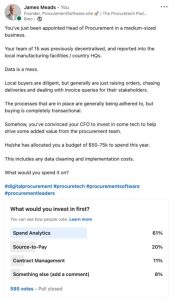
However, it certainly reduces time taken and harmonises the presentation style when creating a category strategy in procurement. Procurement professionals can now concentrate on building and aligning their strategies with their stakeholders and suppliers.
No need to spend time fiddling around in Power Point.
I see these tools as predominantly helping relatively mature procurement teams where there is pressure to deliver more with less. In this environment, category management software could be the ideal next investment.
If your data is clean, then your journey towards world class procurement deserves this next step.