
It’s finally HERE!
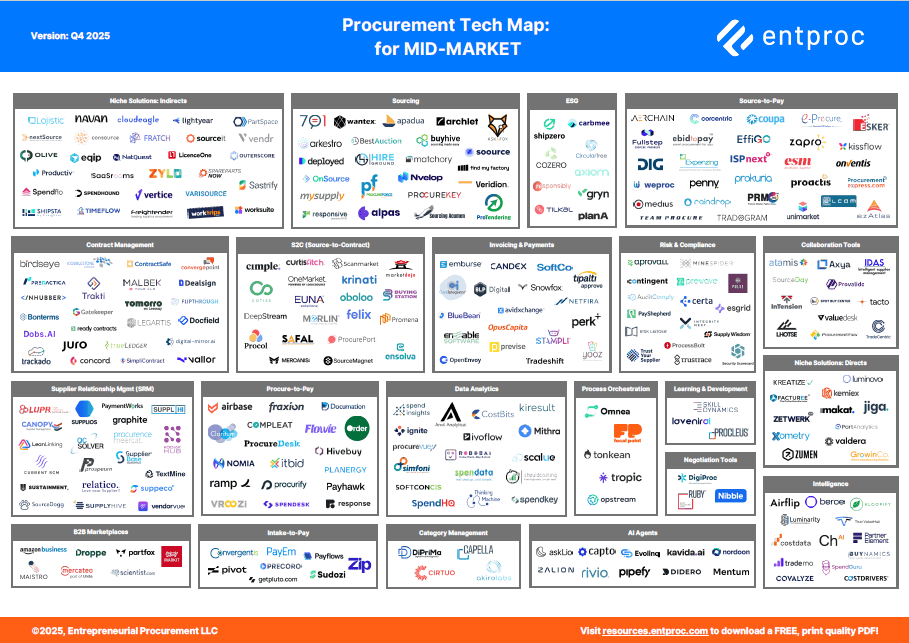
Our Mid-Market Procurement Tech Map has been updated for Q4 2025.
We’re now going to update this every quarter from now on. Things are changing fast, and we’ve got to keep pace!
But, before we get into the details, we need to run through a few key determinants.
How did we choose the companies for our Mid-Market Procurement Tech Map?
In an attempt to answer some of the questions and feedback we receive each time we publish these, this article shares more details about how we put this list together.
First things first.
If you want to get details on the full taxonomy we use, download a free copy of the tech map in our store.
This will also give you the 22 different primary categories we use across our Procurement Software Finder App.
The short summary
The simple answer here is that this Tech Map is not meant to be detailed, academic level research.
If it was, then clearly we would have to charge for this. We would need to hire research analysts, and they don’t come cheap. Those expecting this level of research without paying for it will sadly be disappointed!
We’re also not endorsing any software solutions in this Map.
For transparency, we must point out that a few companies on the Tech Map are our partners whom we work with. Some others are current or former clients of ours in some form.
Neither of these are a prerequisite for including them in the list.
It’s not our intention to make this a “best of” or “top 50 or 100 list”. We’ll leave that to others out there who’ve been doing this for years.
However, without knowing what each individual reader is seeking specifically from any procurement software provider, I do question how useful a “best of” list really is. Which is why we do things a bit differently.
You should view this as a good place to start with your research. Not a definitive list of who the best solutions are.
The longer explanation
With that out of the way, let’s explore some of the criteria we looked at when putting this Tech Map for Mid-Market Businesses together.
Pricing: How does a procurement software company price their product?
Perhaps unsurprisingly, most software providers don’t disclose pricing on their websites for their digital procurement tools. The minority do, but most don’t.
It’s therefore difficult to understand who they’re targeting as customers just on pricing alone. In most cases, you need to have a conversation with a salesperson or book a demo to do this.
With over 420 solutions in our database, this would be almost 6 months of work, even if we had 4 conversations each day.
So, how did we evaluate this?
- Where there was some transparency on pricing, we have included any solution which offers per user / license based pricing. This typically indicates that software is more in line with the as-a-service (SaaS) model.
- A lack of individual customization options usually suggests a more productised software application. Which in turn usually suggests mid-to-low end of the pricing spectrum.
It’s not an exact science, but it’s a useful indicator.
How does their website copy appear?
This is quite a difficult one to describe but after looking through over 400 procurement tech websites, I guess I have a sixth sense.
- As a rule of thumb: the more stuffy and formal looking the website, the more likely the solution is enterprise software.
- Any website that’s written in “consultant speak” is pretty much immediately excluded. The average Head of Procurement in a non-enterprise setting would not understand or have time to read jargon.
- For Business Spend Management (BSM) solutions, it’s easy to tell who their target audience is based on their integrations with accounting, finance and ERP systems. A software targeting SMEs and Mid-Market is usually not going to integrate with SAP and Oracle. However, it probably will offer integration with systems like Sage and NetSuite.
Software companies who have good copywriters and marketing teams will of course nail the copy and the menu items on their website.
As a casual browser on their site, it should be blindingly obvious who they’re trying to sell to. But on many websites, it’s actually really hard to tell.
If they call out mid-market as their core sales audience, we have typically included them in the list. If they don’t specifically call this out, we’ve used other indicators above in their copy and website structure as clues.
Is the solution easy and fast to implement?
Now, let me caveat this first.
Not all customers are equal. A chaotic, dysfunctional customer can still make a mess of an IT project, even for software that’s easy to implement.
Nonetheless, some procurement tech providers are much easier and faster to implement than others.
This is usually down to their:
- Ease of use (UI/UX)
- Fewer and less complex features
- A relative lack of complex customization options.
Solutions which target mid-market businesses will normally sell this point in their website copy and explainer videos. A short implementation is a major advantage over some of the legacy, enterprise suites which take several months to implement.
If this is missing from their marketing material, it’s often a telltale sign that they’re targeting large, corporate customers.
How user-friendly is the digital procurement solution?
The same can be said for user-friendliness. Software companies with an intuitive UI and a modern and smooth UX will be shouting this from the rooftops.
Screenshots of their application, on-demand demos and explainer videos, as well as a slick, beautifully designed website are typical signs that a software company is targeting more agile businesses.
Anyone who is managing a stretched, lean team should see user experience as a non-negotiable.
Nobody in these teams has got the time nor the resources to allocate and train an army of “super users” due to software complexity.
Who are their reference customers?
Any procuretechs who have reference case studies of successful customer implementations will give us a good indication of their target market.
There are some awesome websites out there with customer case studies which make my job easy. Others don’t disclose the customer, or worse still, don’t contain any reference customers. This, of course, makes it harder, and forces us to rely more on the website copy, its look and its feel.
Who are their implementation partners?
Generally speaking, any procurement tech company who requires a traditional consulting firm to be their implementation partner is selling software designed for enterprise customers.
You should not need a complex consulting project and external experts to implement modern procurement software for the mid-market. The time to ROI and the speed of implementation will almost certainly mean that your solution is not a fit for this market segment.
Budgets are tighter in the mid-market and the end customer demands a lean implementation.
Why we’ve separated Intake-to-Pay, Source-to-Pay, and Procure-to-Pay
Increasingly, software companies are offering intake modules. We’ve therefore reflected this in our primary categories.
We’ve now got:
- Intake-to-Pay – which covers the end-to-end process from upstream intake modules, through the whole purchase-to-pay (P2P) cycle. Some of these will include sourcing modules, others may not.
- Source-to-Pay – these contain more detailed sourcing modules, but don’t have intake functionality.
- Procure-to-Pay – these contain neither sourcing nor intake functionality, and are just focused on core P2P from requisition through to payment.
The last time (probably) that we’ll include Invoicing & Payments
We probably won’t include Invoicing & Payments as a section going forward.
Our database is getting big. And these solutions are more Fintech than Procuretech.
So, we’re dropping these when we update it next time.
This is just a superficial overview
Are you still confused?
It’s not surprising. We’re just scratching the surface here.
The market is constantly evolving and becoming more complex as these categories mature and grow.
It’s difficult to pigeon hole different procurement software applications into a box on a poster-sized graphic.
But don’t worry, we’ve got you covered…
Introducing our RFI-as-a-Service
Thinking you could maybe benefit from a white glove service?
We offer a customized RFI-as-a-Service, catered to your individual requirements and criteria.
Here’s how it works
- You tell us what you want the software to do.
- We give you some initial feedback around whether that’s possible in one solution.
- Then, we refine the scope of work and must-haves vs. nice-to-haves.
- We go out and filter all of the software that theoretically offers all or most of these features.
- You get a shortlist of the most relevant solutions, and we then perform a deep dive (demos, sales meetings, Q&A) on each of these.
- We provide the relative strengths and weaknesses of these applications in a report, along with the suggested recommendations as next steps.
All of this can be provided for a fixed cost.
No time-and-materials billable hours.
Typically, this costs around $5,000.
Interested? Book an Intro Call
Time is money. This will enable you to choose the right provider 2-3 months faster than trying to figure it out yourself.
That’s 2-3 months of you reaching the ROI faster, and delivering value to stakeholders.
No wasting your time talking to salespeople from software providers who don’t meet your requirements.
Every week saved in sourcing and sesses and activities.
Let us take you to your destination faster and more efficiently!