
Understanding the difference between Source-to-Contract and Source-to-Pay matters. These aren’t just procurement jargon. They represent fundamentally different approaches to managing supplier relationships and spend.
The software that supports each process is equally distinct. Confusing the two leads to poor technology choices and wasted investment.
This article clarifies what separates S2C from S2P. We’ll explore when to use each approach. Then we’ll examine what to look for when selecting software for either process.
What is Source-to-Contract?
Source-to-Contract covers the strategic procurement lifecycle. It starts with supplier due diligence. It ends with a signed, approved contract.
S2C focuses on high-value, complex sourcing. These are your strategic suppliers. The ones who matter most to your business operations.
The process emphasises total cost of ownership over unit price. It prioritises relationship building and risk mitigation.
What is Source-to-Pay?
Source-to-Pay combines tactical sourcing with transactional execution. It covers competitive bidding, PO placement, goods receipt, invoice processing, and payment.
S2P handles the complete procurement cycle for less critical spend. Think “three bids and a buy” scenarios.
The process is more standardised. Less customised than S2C. Speed and efficiency drive the approach.
Key Steps of Source-to-Contract
The S2C process typically includes seven key stages:
- Due Diligence – Initial supplier research and assessment
- RFI (Request for Information) – Gathering supplier capabilities data
- RFQ/RFP/RFS – Formal competitive bidding process
- Evaluating Bids – Scoring and comparing supplier proposals
- Selecting a Supplier – Final vendor selection
- Authoring and Negotiation – Contract drafting and terms negotiation
- Approval and Signature – Final contract execution
Not every sourcing event follows all seven steps. You might skip due diligence if you’re re-tendering with known suppliers. RFI stages aren’t always necessary for mature supply markets.

Which Steps Does S2C Software Cover?
Most S2C software doesn’t cover the entire process equally. Here’s what to expect:
Due diligence: Not always included. Some platforms offer basic supplier screening. Others integrate with third-party risk databases.
RFI, RFQ, RFP, RFS: Core functionality in all S2C tools. This is table stakes. Ask providers specific questions about AI capabilities. Can it help draft requirements? Optimise event design? Generate specifications?
Evaluating bids: Covered in most but not all tools. The sophistication varies dramatically. Ask what AI can do in this stage. Can it identify anomalies? Suggest evaluation criteria? Normalise supplier responses?
Authoring and negotiation: Often not included. Contract Lifecycle Management software typically handles this. CLM tools offer clause libraries, AI-driven guidance, and negotiation workflows that S2C platforms lack.
Approval workflow: Standard functionality in all S2C software. Expect configurable approval chains and delegation capabilities.
Contract repository: Included in pretty much all S2C platforms. Storage and basic search capabilities are common. Advanced CLM features are not.
Tactical Sourcing vs. Strategic Sourcing
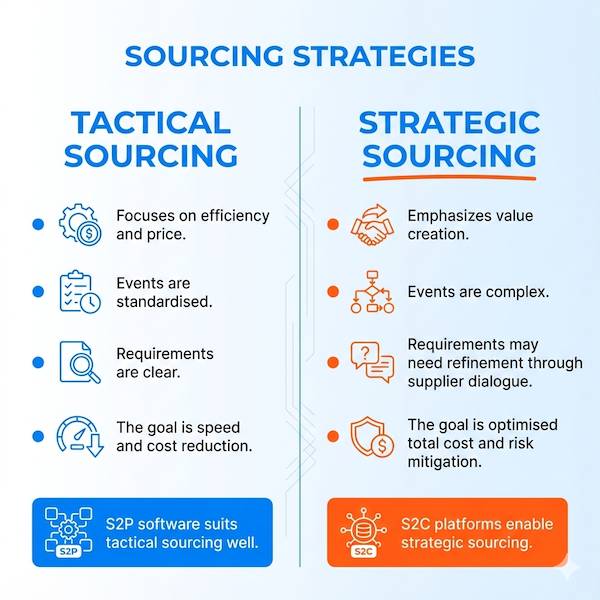
Tactical sourcing focuses on efficiency and price. Events are standardised. Requirements are clear. The goal is speed and cost reduction.
Strategic sourcing emphasises value creation. Events are complex. Requirements may need refinement through supplier dialogue. The goal is optimised total cost and risk mitigation.
S2P software suits tactical sourcing well. S2C platforms enable strategic sourcing.
Sourcing Capability in S2P vs. S2C Software
S2P platforms include basic eSourcing functionality. This works for straightforward competitive bidding.
S2C software provides full-stack RFx capabilities. Deeper evaluation tools. More sophisticated supplier collaboration features.
eAuction functionality doesn’t always come standard in S2C. Some platforms include it. Others don’t. Check before you buy.
S2P suites sometimes include eAuctions for tactical events. The depth varies significantly between vendors.
S2P vs. P2P: Understanding the Difference
S2P includes sourcing activities before the purchase order. P2P starts at the requisition stage.
We covered this distinction in detail in our article on Source-to-Pay vs. Procure-to-Pay.
One key difference: S2P software may include supplier due diligence during onboarding. P2P software typically doesn’t.
S2C platforms don’t always offer supplier onboarding features either. They’re more sourcing-focused than onboarding-focused.
The emphasis differs across all three approaches. S2C prioritises strategic sourcing. S2P balances sourcing with operational efficiency. P2P focuses purely on transaction management.
When Should You Use a Source-to-Contract Approach?
S2C suits:
- Strategic, high-value suppliers
- Bottleneck vendors
- Critical goods and services providers
Only a small percentage of your supplier base typically will represent significant spend. These are the ones where S2C should focus on.
Here’s how a typical procurement team might break down:
| Process | % of Total Spend | % of Total Vendor Count |
|---|---|---|
| S2C | 50% | 5% |
| S2P | 40% | 10-20% |
| P2P | 10% | 75-80% |
Poor S2C processes create downstream problems. Lack of negotiated pricing creates maverick spend risks. Absent contracts mean unclear terms and conditions.
This impacts your P2P operations. Without proper contracts in place, accounts payable faces more disputes. Your procurement team wastes time firefighting supplier issues.
Effective S2C establishes the foundation and enables smooth P2P execution.
What Should You Look for in Source-to-Contract Software?
Selecting S2C software requires asking the right questions. Here are six critical considerations:
1. Do You Need Integration with ERP?
ERP integration matters less for S2C than S2P. S2C doesn’t require seamless invoice payment workflows.
If ERP integration isn’t critical, prioritise user experience. Ease of use drives adoption. Nobody wants clunky, complex software.
User-friendly platforms get used. Complicated ones get bypassed.
2. Do You Need eAuction Capability?
Some S2C platforms include eAuctions. Others don’t.
If competitive bidding through reverse auctions matters to your sourcing strategy, check this feature specifically.
Not every category suits eAuctions. But for those that do, native functionality saves integration headaches.
3. How Advanced Must Post-Event Analysis Be?
Basic bid comparison comes standard. Advanced analytics don’t.
Consider your analytical needs. Will you need complex scenario modelling? Total cost of ownership calculations? Weighted scoring with multiple criteria?
More sophisticated tools offer deeper analytical capabilities. These features cost more. Make sure you’ll actually use them.
4. Where Can AI Do the Heavy Lifting?
AI capabilities vary wildly across S2C platforms. Some use AI for automating RFP creation. Others apply it to bid evaluation.
The newest tools leverage generative AI for specification writing. Some offer autonomous supplier discovery.
Identify your biggest time sinks. Then find platforms where AI addresses those specific challenges.
5. How Much Contract Approval Workflow Do You Need?
Most S2C platforms offer basic approval routing. Enterprise platforms provide complex, multi-stage workflows.
If you need detailed contract authoring, clause libraries, and advanced negotiation features, you probably need dedicated Contract Lifecycle Management software.
S2C platforms paired with CLM tools create a complete solution. S2P plus CLM works similarly.
6. Are You SME, Mid-Market, or Enterprise?
Enterprise businesses often benefit from integrated approaches. Full ERP connection. Complete procurement suites.
Mid-market companies and SMEs profit from best-of-breed agility. Better user experience. Faster implementation.
Platforms like Coupa and SAP Ariba suit large enterprises. Their complexity works against smaller organisations.
Poor UI and UX kills adoption. Long implementations delay ROI. Mid-market teams struggle to justify the investment.
Can S2C and S2P Be Performed in One Software Suite?
Yes, they can. But you’ll make trade-offs.
All-in-one suites sacrifice features and user experience. There’s no perfect answer. The right choice depends on your priorities.
Do you value everything in one place with ERP integration? You’ll accept some clunkiness.
Do you prefer agile solutions with better UX and customisation? You’ll manage multiple platforms.
The Rise of Intake-to-Pay as an Alternative
Traditional S2P suites are facing new competition. Intake and Process Orchestration software represents a different approach.
These platforms start at the very beginning. Before the requisition. At the intake stage where needs are first expressed.
Intake-to-Pay solutions offer several advantages:
- Modern, intuitive interfaces
- Faster implementation
- Native AI capabilities
- Better workflow flexibility
- User-friendly front ends
Platforms like Zip, Omnea, and Pivot demonstrate this trend. They’re capturing market share from traditional S2P vendors.
For greenfield implementations, intake-to-pay makes sense. For established enterprises with legacy systems, orchestration tools offer a middle ground.
The complete analysis of how these solutions compare to traditional S2P suites is available in our article: Will Intake and Process Orchestration eat Source-to-Pay?
Conclusion
S2C and S2P serve different purposes. S2C handles strategic sourcing. S2P manages tactical procurement and transactional execution.
The software supporting each process reflects these differences. S2C platforms prioritise supplier collaboration and contract management. S2P suites emphasise operational efficiency and payment automation.
Your organisation’s size, maturity, and strategic priorities determine the right approach. Most procurement teams need both. The question isn’t which to choose. It’s how to implement each effectively.
Mid-market companies often benefit from best-of-breed solutions. Enterprises may prefer integrated suites. Newer intake-to-pay platforms offer compelling alternatives to both.
The procurement technology landscape continues to evolve. Understanding these fundamental distinctions helps you navigate your options effectively.