
Category-specific procurement tools – both in the direct and indirect spend space – are quietly booming. Even now, with a lot of talk about a stark consolidation of procurement SaaS solutions, I’m extremely bullish about this specific part of the market.
Why?
Because these specialised solutions are answering needs that traditional Source-to-Pay (S2P) suites simply weren’t built to meet.
Let’s shine a light on why category-focused procurement tools are seeing such impressive momentum, and why they deserve a spot on your tech radar.
The Limits of S2P Suites vs. Category-Specific Procurement Tools
The first reason for the rise of category-specific procurement apps is simple: the major Source-to-Pay suites are not suitable for covering these categories in detail.
Traditional, legacy S2P platforms like SAP Ariba, Coupa, Ivalua, GEP, and Jaggaer were designed to address a broad range of sourcing and procurement activities. However, when you zoom into very specific categories, the “one-size-fits-all” approach starts to break down.
They may in theory support “all suppliers and all spend”, as one of them used to have as their marketing tagline. But have you tried to run an RFP for ocean freight or to perform SRM for a marketing agency in one of the software suites? Then you’ve probably identified some of their shortcomings.
Specialised spend categories often require:
- Unique sourcing evaluation criteria
- Different supplier management approaches
- Complex compliance needs
- Category-specific KPIs
A generic procurement platform struggles to deliver the depth and flexibility needed without heavy customisation, which is costly and time-consuming.
Category-specific procurement tools fill this gap, offering purpose-built workflows for these specific needs, right out of the box.
Bespoke Software for Critical Categories = Easy ROI
When you have high spend or criticality for any of these categories, a bespoke software solution can easily deliver ROI.
Consider asset management for IT and telecoms. Traditional procurement platforms may capture a laptop purchase order, but they can’t:
- Manage software licensing renewals
- Track device usage over time
- Ensure compliance with vendor agreements.
Specialised IT procurement platforms offer these capabilities natively. When spend is high or the category is mission-critical, even a small percentage of cost optimisation or risk reduction easily justifies the investment.
Critical Spend = Higher Focus and Easier Budget Approval
Category-specific tools also thrive because critical spend areas get high focus inside organizations. Whereas Procurement as a business function more generally often doesn’t get this focus.
When specific teams within a procurement organisation tackle spend categories that are:
- Very administrative or time-consuming;
- Business-critical; or
- Highly visible to leadership,
It’s far easier to get buy-in for investment in new tools. Unlike broader procurement projects that may feel abstract, category-focused solutions solve a visible, painful, and immediate problem.
Pricing for Specialised Procurement Tools is Within Reach
Another major shift is the proliferation of these tools and the downward trend for pricing.
Category-specific procurement tools are not out of reach anymore.
Ten years ago, implementing best-of-breed procurement solutions often meant high IT consulting fees, lengthy deployments, and hefty software licenses.
Today, SaaS models and scalable platforms mean that specialised procurement tools can start small and scale as needed.
Even as prices for software licenses have risen, there have been a proliferation of solutions which focus on SME and mid-market organizations.
Examples:
- A contingent workforce management platform might charge based on number of contractors managed through the application.
- A SaaS procurement solution could offer a scale of pricing based on total spend managed.
This democratisation makes category-specific tools viable for a much larger pool of potential customers.
No Longer Just Focused on Large Enterprise Problems
In the past, many procurement tech vendors only catered to large, multinational enterprises.
But today’s best-of-breed vendors offering category-specific procurement tools understand that smaller procurement teams have very specific pain-points too.
They are building:
- User-friendly interfaces
- Quick implementation models
- More flexible pricing structures
This means a 500-employee manufacturing business or a high growth tech scale-up can deploy the same category-specific tools that used to be reserved for billion dollar enterprises.
The focus is shifting from “solving big company problems” to solving important category problems, no matter the company size.
Easier Integration thanks to APIs and Marketplaces
Major S2P suite vendors have noticed the trend toward specialisation.
Established ERP providers and S2P suites, most notably SAP, Oracle, Microsoft and Coupa, now have app marketplaces. Through these marketplaces, best-of-breed tools that solve category-specific problems can now access this huge potential customer base.
Companies can thus discover, trial and easily integrate category-specific procurement tools without leaving or replacing their foundational procuretech stack.
Integration barriers used to be a real headache.
Thanks to modern APIs, middleware, and standard data protocols, category-specific procurement tools can often:
- Integrate with ERPs like SAP or Oracle in weeks, not months
- Sync with SRM platforms to align supplier data
- Embed into e-signature, compliance, and payment systems seamlessly
This has further lowered the barrier to adoption.
Instead of rip-and-replace projects, procurement teams can now adopt specialised tools as extensions of their existing ecosystems.
Best-of-Breed is no Longer a “Risky Option”
In the past, procurement teams defaulted to “buy everything from one vendor” because integrating multiple systems was seen as too risky.
Procurement leaders now recognize that:
- No single vendor will ever do everything perfectly.
- Focused tools often outperform mega-suites on user experience and category-specific functionality.
- Modern IT security and interoperability standards make managing multiple tools much easier.
- Choosing a best-of-breed solution for critical spend categories is no longer a high risk or maverick decision.
Rising Compliance and Audit Requirements in Direct Spend
Especially for direct spend categories like raw materials, packaging, and manufacturing services, the need for compliance and audit trails has exploded.
Regulatory pressures around:
- Sustainability and CO2 emissions reporting
- Material traceability
- Corporate social responsibility (CSR)
mean that tracking critical spend and supplier relationships in spreadsheets is becoming ever-riskier.
Category-specific procurement tools are often built with:
- Full audit trails
- Automated compliance checks
- Reporting dashboards
This makes them essential in industries like aerospace, automotive, pharmaceuticals, and food production, where compliance lapses can have catastrophic consequences.
Indirect Spend is the Final Frontier of Opportunity
Finally, Procurement historically often did not have a mandate to manage all areas of indirect spend. This is especially the case in areas like marketing, IT and corporate services, where politics and stakeholder relationships can be challenging.
Why?
- These spend categories were considered “business as usual” expenses;
- Data quality was poor;
- Contract visibility was limited.
Today, companies increasingly realise that indirect spend – and the lack of strategic spend and supplier management often present in these categories – creates:
- Hidden risks;
- Untapped savings opportunities;
- Supplier fragmentation.
Category-specific procurement tools in these areas offer:
- Advanced contract and vendor lifecycle management;
- Spend visibility dashboards;
- Superior and tailored sourcing modules.
There are now the tools out there to tame and control the last remaining “Wild West” categories of spend.
How to find the Category-Specific Procurement Tools your Business Needs
Luckily, we’ve put together a whole Tech Map just for niche category specific procuretech. It’s a print-ready PDF and also has links to all the software solution pages in our database!
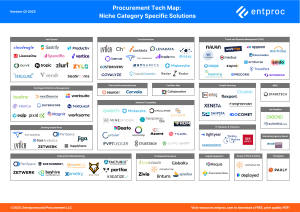
We’ve also got two separate pages in our Software Finder where you can browse:
Need more specific advice?
If you’re a Consultant and need to perform more detailed search comparisons, you can access our paid back end database via a 1-year (gold) or 3-month (silver) subscription.
Want to see a more detailed demo of what it can do?
Book an intro call and I would love to show you.
FAQ
Q: What is a category-specific procurement tool?
A: It’s a procurement software designed specifically for managing a particular spend category, such as IT services, marketing, logistics, or direct materials.
Q: Are these tools only for large enterprises?
A: No, today’s category-specific tools are priced and designed for mid-market companies as well as large organizations.
Q: How do category-specific tools integrate with existing systems?
A: Most modern tools offer APIs and pre-built connectors that make integration with ERP, S2P suites, and SRM/SQM systems straightforward.